
Competitive Strategy
Competitor Outranking Your Website: How to Diagnose SERP Displacement
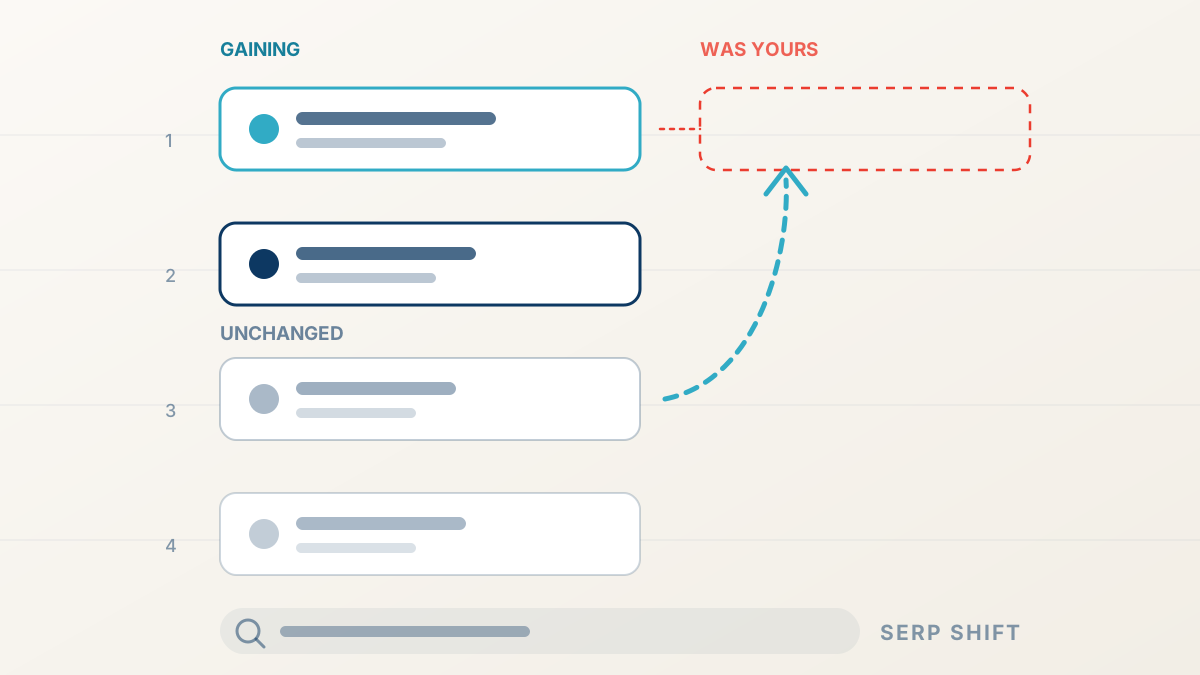
Your site didn't change, yet a competitor took the top position. Here is how to diagnose SERP displacement: intent shifts, entity coverage, topical clusters, fresh content, and SERP feature absorption.
Key takeaways
- Displacement occurs when competitors build closer alignment with evolving user intent, distinct from manual actions or technical crawl penalties.
- Search intent drifts over time, frequently shifting commercial search results from single-vendor sales pages toward comparison tools and transparent pricing tables.
- Google rewards entity depth and information gain, prioritizing pages that provide primary data and structured attributes missing from competing documents.
- Topical clusters and contextual internal links pass topic-specific authority to target pages, outperforming standalone articles that lack internal site support.
- SERP features such as AI Overviews and featured snippets absorb organic click share even when classic organic position numbers appear stable.
Relative displacement versus search engine penalties
When a website slips from position one to position four on a high-value commercial query, website owners frequently assume their domain suffered a penalty. They search for technical crawl errors, inspect Google Search Console for manual action notices, and wonder what code broke during the last deployment. In most cases, nothing broke on the site. The page is identical to the day it ranked first.
Organic search rankings are relative, not absolute. Google re-evaluates the candidate document pool for commercial queries every time its web crawlers index newer documents and process user satisfaction signals. A penalty occurs when a site violates search spam policies, resulting in a manual action or algorithmic suppression across entire subdirectories. Displacement occurs when a competing publisher builds a resource that search algorithms evaluate as a closer match for user expectations.
Displacement leaves a specific signature in Search Console: total domain indexation remains healthy, technical health scores stay green, and impressions on informational terms remain stable. The loss concentrates on specific competitive queries where a rival URL moved directly above yours. Diagnosing displacement requires an external audit of what the outranking page offers that your document omits.
A penalty pushes a page down across all related terms regardless of competitor activity. Displacement moves your page down only because another specific URL scored higher on relevance, freshness, or topical authority.
Audit search intent shifts on the target query
Search intent is not permanent. Search algorithms continuously observe how users interact with search result pages. If searchers enter a commercial query, click a standard service sales page, bounce back to the results, and select a third-party comparison matrix, Google learns that user intent has shifted from transactional purchase to comparative evaluation.
A common cause of displacement occurs when a service provider ranks with a traditional lead generation page, but competitors launch comprehensive comparison tools, calculator widgets, or transparent pricing breakdowns. For example, a query such as enterprise cloud backup may historically have ranked vendor landing pages. Over time, search results reorganize to favor independent comparison tables with explicit feature matrices. If your page remains a lead generation form while a competitor provides an interactive pricing calculator, the competitor earns higher user engagement and takes top placement.
To audit intent drift, open an incognito browser window or use an unpersonalized search proxy. Examine the top five ranking URLs for your target search term. Note the dominant page format: are the winning pages product landing pages, multi-brand comparison roundups, technical documentation guides, or interactive tools? If the format of the top three results differs from your page structure, your document no longer matches the intent profile Google rewards for that query.
Evaluate entity coverage and topical cluster depth
Modern search ranking systems evaluate content using semantic entity graphs rather than raw keyword frequency. Google assesses how thoroughly a document covers the sub-attributes, technical requirements, related concepts, and practical constraints associated with a primary topic. When a competitor outranks an established page, entity gaps are often the reason.
If your article discusses business continuity planning by providing a high-level summary, a competitor who covers specific regulatory standards (such as ISO 22301), recovery time objectives (RTO), recovery point objectives (RPO), and emergency communication workflows establishes greater semantic coverage. Natural language processing models evaluate their page as a more comprehensive reference for user queries.
Entity coverage extends beyond a single URL to the surrounding topical cluster. Google evaluates the topical authority of a domain based on the depth of supporting content. A standalone commercial page rarely maintains top rankings against a competitor supported by an interconnected library of supporting articles. If your competitor built dedicated guides explaining individual subtopics and connected them to their primary service page using descriptive internal anchor text, their target page receives concentrated topical PageRank. Your isolated page falls behind because it lacks supporting architectural context.
Extract entity terminology from top competitors
Analyze the top three ranking pages using natural language processing tools to identify technical attributes, standards, and subtopics your page neglects.
Map internal link architecture
Count the number of contextual internal links pointing to your target page versus the internal links supporting the competitor URL.
Identify orphaned subtopics
Locate related questions searchers ask that currently lack dedicated coverage across your existing website directory.
Audit internal anchor text variety
Replace generic anchor text such as click here or learn more with descriptive, entity-rich anchors linking into your primary target page.
Compare information gain and verifiable primary evidence
Google holds patents focused on information gain scores. When multiple pages rank for a query, search algorithms measure how much novel, incremental information each document adds beyond what already exists in the search index. If your page repeats standard definitions and general industry advice, it carries a low information gain score.
Competitors take top positions by publishing original data: proprietary benchmark tests, dated survey results, documented case studies, verified pricing sheets, and direct product teardowns. When an algorithm evaluates two pages covering the same topic, the document containing first-hand measurements, custom charts, and named technical sources outranks the document containing generalized restatements.
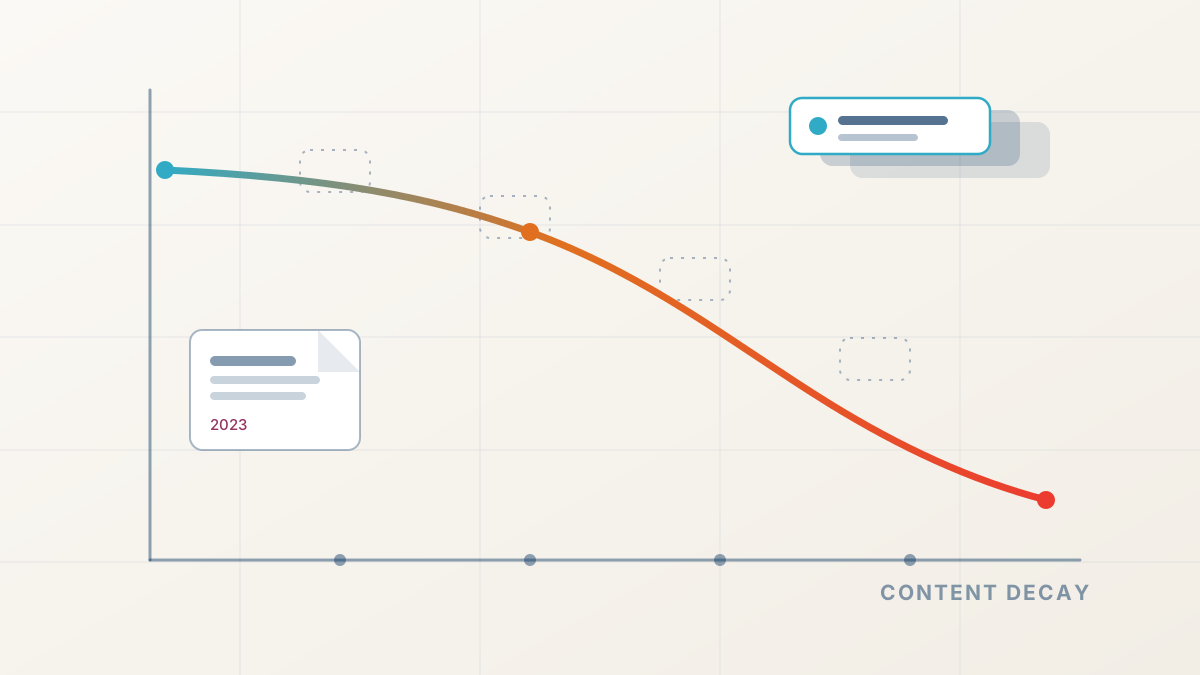
Content freshness also accelerates displacement. Search engines track how recently facts, product models, and technical instructions were reviewed. If your page references software versions, pricing tiers, or regulatory frameworks from eighteen months ago while a competitor published verified data updated within the last sixty days, Google demotes your listing to protect searchers from outdated information. Refreshing a page requires adding new substantive evidence, not simply updating the copyright date in the footer.
“Rankings are lost when competitors publish facts you omitted. Recovery requires adding primary data and original proof that existing search results do not contain.”
Measure click absorption by AI Overviews and rich features
Sometimes a competitor displaces your organic traffic without ever outranking your URL in classic blue-link positions. The search engine results page itself can absorb your click share through rich features and AI Overviews.
Google frequently injects AI Overviews, Featured Snippets, People Also Ask dropdowns, and video carousels above standard organic listings. If a query displays an AI Overview followed by a three-pack map module, the organic position one listing is pushed well below the desktop screen fold. If your competitor structured their content with concise definition sentences, clear HTML table markup, and numbered sequential lists, Google extracts their text into the featured snippet or cites their domain in the AI Overview.
In this scenario, your rank tracking tool may show your URL stable at position two, yet Search Console records a fifty percent reduction in clicks. The competitor won the click not by moving ahead in organic links, but by formatting their content to capture zero-click and snippet features. Auditing displacement requires examining total visual pixel height on the SERP, checking which domains earn citations inside AI Overviews, and identifying which rich schema formats appear above standard web results.
Audit link velocity and authoritative brand citations
Content and structure matter, but external link equity remains a primary foundation of search engine ranking algorithms. When a competitor climbs past you, inspect backlink velocity across both URLs over the preceding ninety days.
Examine the referring domain profiles of both competing pages. Did the competitor publish an original research study that earned editorial backlinks from industry news publications? Did they launch an interactive tool that acquired university or trade organization citations? If a rival page gained fifteen high-authority referring domains while your URL gained none, the resulting increase in PageRank can push them into position one.
Look beyond exact URL backlinks to domain-level brand mentions and unlinked citations. Google uses unlinked brand mentions and co-occurrences in authoritative publications to evaluate entity prominence. If a competitor has been featured in podcasts, digital press releases, industry panels, and professional directories, their overall domain trust rises, elevating their commercial pages across shared search queries.
Build a differentiated recovery plan without copying
When business owners discover an outranking competitor, the instinctive reaction is imitation: copying their heading structure, duplicating their word count, and replicating their page layout. Imitation is an ineffective strategy. A copy arrives in the search index second, carries zero information gain, and competes without the established authority that enabled the competitor to win.
The proper recovery strategy is differentiated superiority. Review the competitor page to find its omissions, weaknesses, and outdated claims. Did they skip pricing figures? Add transparent pricing tables. Did they provide hypothetical advice? Add verified case study metrics and primary data. Did their page load slowly on mobile? Optimize your asset delivery and Core Web Vitals to deliver a faster experience.
Structure the revised content to target featured snippets using direct, sixty-word answers beneath descriptive H2 headings. Build three to five supporting cluster articles addressing adjacent technical questions, and link them directly to your target URL. When widespread displacement occurs across dozens of product or service pages, a formal ranking drop diagnosis establishes whether you are facing pure competitive displacement or algorithmic quality re-evaluations. To evaluate your page speed, canonical headers, and metadata against competing URLs, test your site with our free SEO audit tools.
Ranking Drop Diagnosis
Find out why your rankings dropped
FastestRank dates your traffic loss, ties it to a documented cause, and ranks the fixes: a human-reviewed diagnosis, not an automated checklist.
Sources
FastestRank Editorial
Ranking Recovery Desk
FastestRank Editorial dates and diagnoses ranking drops for business owners, separating verified causes from guesswork before any recovery work begins.
Continue Reading
Related Articles
Market Intelligence
Competitors Outranking You: How SERP Displacement Works
Your rankings look stable while your traffic falls. When a competitor earns the result Google prefers, the fix is differentiation, not imitation.
FastestRank Editorial6 min read
Core Updates
Content Decay: Why Old Pages Stop Ranking
Steady pages slowly lose visibility quarter over quarter. That slope is content decay — and refreshing it takes evidence, not just a new publish date.
FastestRank Editorial6 min read
Technical SEO
How to Find Out Why Your Website Lost Traffic
Analytics confirms that visitors stopped arriving, but only Search Console reveals why. Here is the step-by-step diagnostic workflow to isolate dropped pages, queries, and crawl errors.
FastestRank Editorial8 min read